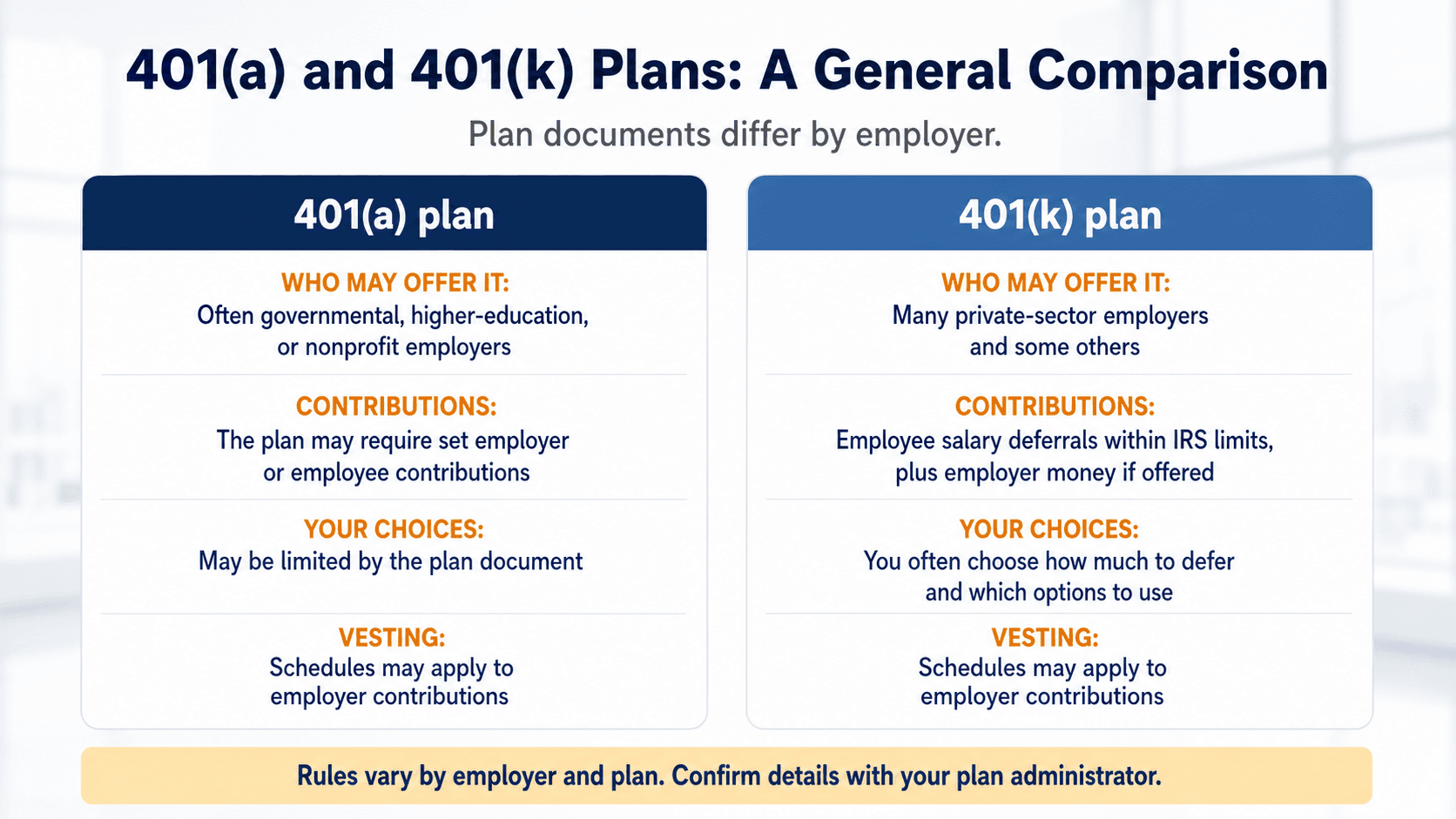
A 401(a) plan is an employer-sponsored retirement plan whose contribution formula is set in the plan document and may require set contributions, while a 401(k) is built around employee salary deferrals. University employees may have both, plus a 403(b). Vesting, investments, and rollover options depend on each plan's terms.
For households across Allentown, Bethlehem, and Easton, the benefits sheet at a college or university can list several plan names, and the 401(a) is often the least familiar. This guide explains how a 401(a) compares with a 401(k), what the IRS says about 2026 limits, and what faculty and administrators may want to confirm with their benefits office. It is educational, and it does not recommend a plan, a contribution level, or an investment for any individual.
Sources and as-of date: the IRS rules summarized below come from the IRS pages linked in each section, reviewed October 7, 2026. Plan rules vary by plan document, and tax law can change, so check the IRS pages and your own plan documents for the current version.
401(a) vs 401(k): The Short Version
The names can be confusing because a 401(k) is itself a type of qualified plan. The IRS describes a 401(k) plan as a qualified plan with a feature that lets an employee elect to have the employer contribute a portion of wages to an individual account. In everyday benefits language, though, "401(a) plan" often refers to an employer-funded plan where the plan document sets who contributes and how much. Here are the main differences to look for:
- How money gets in. A 401(k) is built around employee elective deferrals, with optional employer contributions. A 401(a) usually follows a formula in the plan document, which may require set employer contributions, set employee contributions, or both.
- How much control you have. In a 401(k), you generally choose how much to defer, within IRS limits. In a 401(a), the amount may be fixed by the plan, so you may have little or no say over it.
- Who tends to offer it. A 401(k) is common at private employers. A 401(a) may be offered by public colleges and universities and other governmental employers, and some private nonprofits may offer one as well.
- How it pairs with other plans. A 401(a) may sit alongside a 403(b) or 457(b), where employees can often choose to contribute on their own.
Every plan is governed by its own plan document, so confirm the details with your employer's benefits office or plan administrator.
Who Is Offered Each Plan
Under the IRS definitions, a 403(b) is a plan offered by public schools and certain tax-exempt organizations, and ERISA covers most voluntarily established private-sector plans. The IRS also notes that a governmental 401(a) plan may only be established and maintained by a governmental entity. Putting that together:
- Public colleges and universities and other government employers. A 401(a) may hold required contributions, and a 403(b) or 457(b) may be offered for voluntary savings.
- Private nonprofit universities, colleges, and health systems. The mix varies. Some employers offer a 403(b), some add an employer-funded plan under section 401(a), and some offer a 401(k).
- For-profit private employers. A 401(k) is the more common workplace plan.
Faculty and administrators who move between institutions, or who have worked in more than one sector, may end up with several different account types. Our guide to the difference between a 401(k) and a 403(b) covers the plans most often offered at universities and hospitals.
How Contributions Work
401(k) contributions. Under the IRS description, an employee can have pay deferred into the plan, before or after tax depending on the options offered, and the employer may add matching or other contributions. Pre-tax deferrals reduce current taxable income, and Roth deferrals are taxed now with different treatment later. Both involve trade-offs, such as plan fees and possible taxes and penalties on early withdrawals.
401(a) contributions. A 401(a) plan's formula may call for the employer to contribute a set percentage of pay, and it may require employees to contribute as well. The IRS describes a money purchase plan as one that requires set annual contributions from the employer. For governmental plans, the IRS notes that employer "pick-up" arrangements can treat certain contributions that would otherwise be employee contributions as employer contributions for federal income tax purposes, if requirements are met. Whether and how your plan does this is a question for your plan administrator.
What you can and cannot change. A required contribution may not be adjustable. That can support steady saving, but it also means less flexibility if your cash-flow needs change.
2026 IRS Limits
These figures come from the IRS and were checked on October 7, 2026. The IRS adjusts them for cost of living, so they may change in future years.
- Employee elective deferrals (401(k), 403(b), and governmental 457(b)): $24,500 for 2026.
- Age 50 and older catch-up, if the plan allows: $8,000. For ages 60 through 63, the limit is $11,250 instead of $8,000.
- Defined contribution plan limit: $72,000 for 2026 (or 100% of compensation, if less, under the usual rule). The IRS defines annual additions as the total of employer contributions, employee contributions (not including rollovers), and forfeitures allocated to a participant's account in a year, which is why required contributions in a 401(a) generally count toward this limit.
- Annual compensation limit used in plan calculations: $360,000.
Sources: IRS, COLA increases for dollar limitations on benefits and contributions and 401(k) limit increases to $24,500 for 2026. Figures as of October 7, 2026.
Required contributions to a 401(a) are generally not elective deferrals, so they work differently from the $24,500 deferral limit. How your 401(a), 403(b), and any 457(b) fit together depends on the plans' terms and your employer, so ask your plan administrator how the limits apply to you.
Investment Choices
In a 401(k), the IRS notes that the employee often chooses investments from the options provided under the plan. A 401(a) can work differently. Some plans let participants pick from a menu, some use a default option chosen by the employer, and some use a mix. Consider asking:
- Do I choose the investments, or does the plan choose for me?
- What does the menu include, and what do the investments and the plan cost? Fees reduce account value, and they are disclosed in plan materials.
- Can I change my choices over time? Investing involves risk, including the potential loss of principal.
Vesting
Vesting means ownership. The IRS says an employee's own contributions are always 100% vested, and that qualified defined contribution plans can use a variety of schedules for employer contributions, from immediate vesting to schedules that increase with years of service, as set by the plan document. The IRS also says all employees must be 100% vested by normal retirement age under the plan or when the plan is terminated.
For a 401(a), this matters because the employer may be the main source of contributions. A plan with a multi-year schedule could mean that leaving early forfeits part of the employer's contributions. The IRS notes that governmental plans must meet the vesting requirements in effect on September 1, 1974, which can differ from the rules for private-sector plans, so a public university's schedule may look different from a private employer's. Your summary plan description or annual benefits statement will show your own schedule.
What Happens at Retirement or When You Change Jobs
When you leave an employer or retire, the options for a 401(a) or a 401(k) are often similar. They may include leaving the money in the plan, moving it to a new employer's plan if permitted, rolling it over to an IRA, or taking a distribution. Each has different rules, costs, and tax consequences.
- Rollovers. The IRS says most pre-retirement payments from a retirement plan can be rolled over to another plan or an IRA, through a direct rollover or within 60 days of receipt. If you do not roll over a payment, it may be taxable and could also be subject to an additional 10% tax unless an exception applies. Required minimum distributions cannot be rolled over.
- Plan terms control. A 401(a) may limit when you can take money out, and some plans restrict withdrawals while you are still working. Ask your plan administrator what is allowed.
- Roth rollovers. Some households review whether to move pre-tax plan money into a Roth account when they leave an employer. The converted amount is generally taxable, so it is worth reading our guide to converting a 403(b) or 401(k) to a Roth and confirming the details with a tax professional.
- Early retirement. If you leave at 55 or older, a separate IRS exception to the 10% tax may apply to certain employer plans but not to IRAs. Our Rule of 55 guide explains the trade-off of rolling a plan into an IRA.
- Retirement income. Account withdrawals are one piece of income alongside Social Security and other sources. Our retirement income planning article explains how accounts may fit into a distribution plan, and our guide to managing your retirement plan outlines the decisions at a job change.
How a 401(a) Fits With a 403(b) or 457(b)
Many university benefits packages combine plans, and the pieces can play different roles:
- 401(a). May receive required employer contributions, and sometimes required employee contributions, set by the plan.
- 403(b). Often allows voluntary salary deferrals, and some employers also contribute. The IRS lists a 2026 elective deferral limit of $24,500, with possible age-based and 15-year service catch-ups if the plan allows.
- 457(b). If your employer offers one, the IRS lists a separate 2026 deferral limit of $24,500 for 457 plans, and its catch-up rules differ from those of a 403(b).
Because the required piece is fixed, the voluntary pieces are where many households can adjust. How much to save, which account type to use, and how to coordinate the accounts with taxes and a future income plan are individual decisions with trade-offs. Faculty and administrators who spend many years at one institution can end up with several accounts, so a periodic review of the whole picture may be useful.
Questions to Ask Your Benefits Office
- Which plans am I enrolled in, and which am I eligible for? Confirm whether you have a 401(a), 403(b), 457(b), 401(k), or more than one.
- Are any contributions required, and what percentage? Ask whether you and the employer both contribute.
- What is my vesting schedule? Ask how years of service are counted.
- Who chooses the investments, and what do they cost?
- What are my options if I leave or retire? Ask about rollovers, installment payments, and timing.
- Who is my beneficiary, and when was it last reviewed?
How Wealthcare of the Lehigh Valley Can Help
Wealthcare of the Lehigh Valley works with higher-education faculty and administrators, medical professionals, and other pre-retirees and retirees across Allentown, Bethlehem, Easton, and the broader Lehigh Valley. Our retirement plan management service looks at employer plans such as a 401(a), 403(b), 457(b), and 401(k) as part of a broader financial plan. Outcomes depend on your circumstances, plan rules, tax law, and market conditions. You can review our fee schedule to see how we charge.
If you would like to talk through your employer's plans, you may schedule a consultation with our team.
Frequently Asked Questions
What is the difference between a 401(a) and a 401(k)?
A 401(k) is a qualified plan with a feature that lets employees defer part of their pay. A 401(a) plan generally sets contributions through its plan document, which may require set employer or employee contributions. Many university employees have a 401(a) and a 403(b) or 457(b), and the terms depend on the employer's plan.
Are 401(a) contributions mandatory?
They can be. A plan document may require the employer, the employee, or both to contribute set amounts, and employees often cannot change those amounts. Some plans work differently, so check your summary plan description or ask your benefits office how contributions are set.
Can I have a 401(a) and a 403(b) at the same time?
Yes, some employers offer both. A 401(a) may hold required employer contributions, while a 403(b) may allow voluntary salary deferrals. Whether both are available depends on your employer and job classification, and each plan has its own rules and limits.
Do I own my 401(a) employer contributions right away?
Not necessarily. The IRS says an employee's own contributions are always 100% vested, while vesting for employer contributions depends on the plan and plan type. Public-sector plans may follow different vesting rules, so confirm your schedule with your plan administrator.
Can I roll over a 401(a) when I leave my employer?
The IRS says most pre-retirement payments from a retirement plan can be rolled over to another plan or an IRA, either directly or within 60 days. Your plan's distribution rules, taxes, and fees all matter, so compare your options before you act.
Next Step
Retirement accounts work best when they are reviewed alongside the rest of your plan. These resources may help you take the next step:
- Retirement income: Retirement income planning and our income planning service.
- Taxes: Tax planning benefits and our tax planning service.
- Estate and legacy: Estate and legacy planning and our estate planning service.
- Talk with us: Contact our team to discuss your employer's plans.
This article is for general educational purposes and is not individualized tax, legal, or investment advice. Plan terms and tax rules vary, so consult a qualified professional about your situation.
Wealthcare of the Lehigh Valley