A single stock position can become a meaningful part of a household's financial picture for many reasons. It may have grown over a long career, arrived through employer compensation, been inherited, or been retained because of a personal connection to the company. The position may represent years of work and disciplined saving.
That history is important, but it can also make the planning decision more complex. When one company represents a substantial share of wealth, the household is exposed not only to broad market conditions but also to events specific to that company and its industry. For households approaching retirement, the question is not simply whether the stock has done well in the past. It is how the position fits with income needs, taxes, other assets, and the legacy the household intends to leave.
This article is educational and is not a recommendation to buy, sell, or hold any security. Decisions involving a concentrated position depend on individual circumstances, account restrictions, tax law, market conditions, and personal goals.
What Is a Concentrated Stock Position?
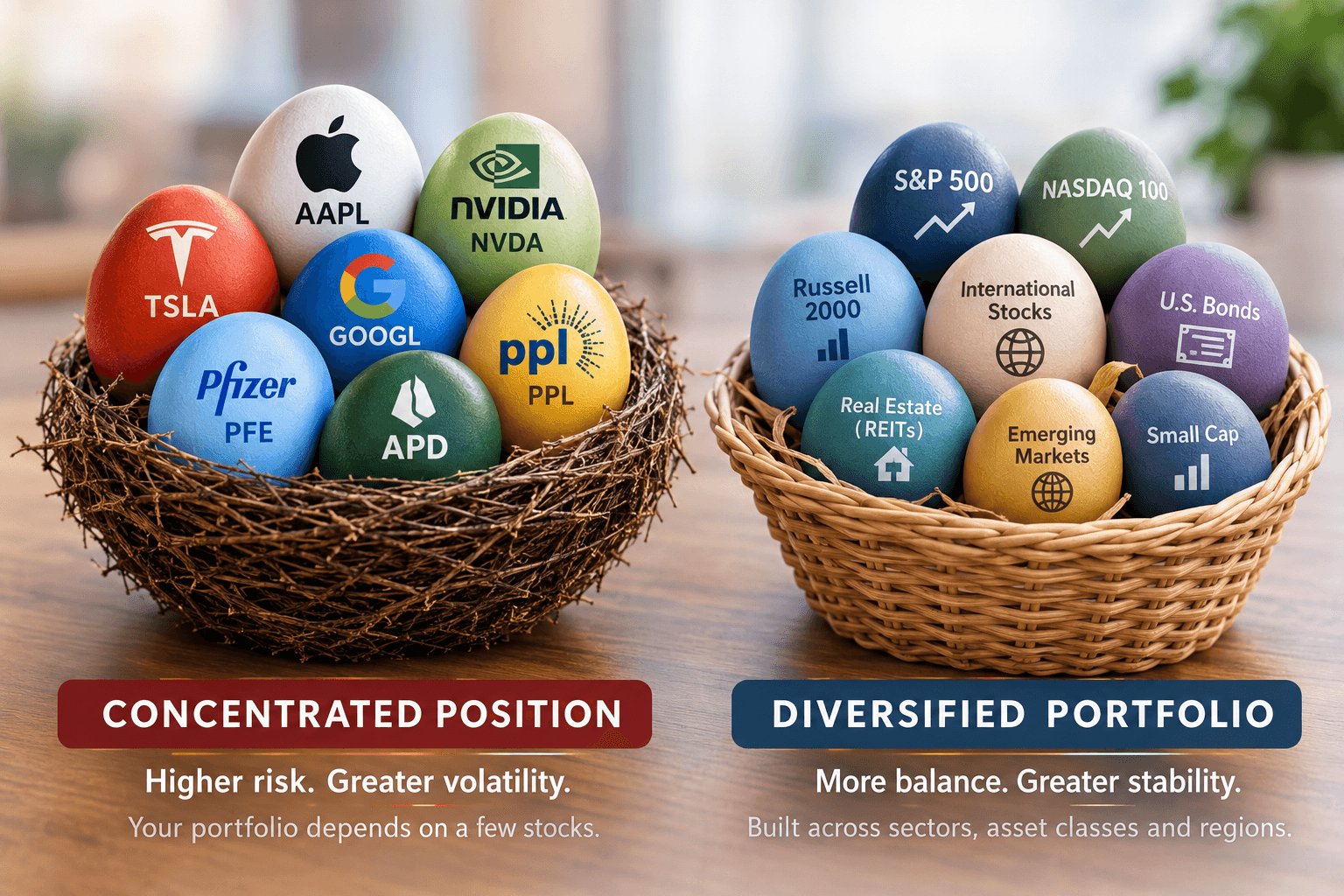
A concentrated stock position is a holding in one company that represents a large portion of a household's investable assets or net worth. There is no single percentage that defines concentration for every household. A position that may be manageable for one household could create a very different level of exposure for another.
The context matters. A concentrated position can be more consequential when:
- The same company also provides the household's salary, bonus, or benefits
- Retirement is near and the portfolio may soon support withdrawals
- The position has a low cost basis, making a potential sale tax-sensitive
- Much of the household's charitable or legacy planning is connected to the shares
- Company trading windows, plan rules, or legal restrictions limit flexibility
- Other savings are limited or similarly tied to the same industry
The goal of a review is not to apply a universal rule. It is to understand where the household depends on one holding and what trade-offs may be involved in changing or keeping that exposure.
The Risk Is Bigger Than Day-to-Day Volatility
Broad market movement affects many investments. A concentrated position adds another layer of risk because the holding can be affected by company-specific developments, management decisions, competition, regulation, litigation, or changes in its industry. These factors may cause the position to behave differently from the wider market.
When a household's employment and investments are connected to the same company, the exposure can be even more closely linked. A business disruption could affect compensation, benefits, and the value of a major holding at the same time. That overlap may be especially important to assess for professionals with employer stock or equity-based compensation.
Diversification is designed to manage some forms of investment risk by reducing dependence on any one holding. It does not eliminate loss or make a portfolio stable in every market environment. As discussed in our risk management article, the more useful question is how an investment risk connects to the rest of the household's plan, including liquidity needs, income timing, and the ability to adjust spending if circumstances change.
The Map: Financial Planning Starts With the Full Picture
Financial planning provides the map for evaluating a concentrated position. Before considering any transaction, a household can clarify the role the shares play in its overall financial picture.
Questions may include:
- What goals are these assets intended to support?
- How much of the household's future retirement spending depends on this position?
- What other assets, income sources, and reserves are available?
- How much flexibility exists if the value of the holding changes materially?
- Are there upcoming needs, such as retirement, education costs, a home purchase, charitable giving, or family support?
In our article on why financial planning matters, we describe how investments, income, taxes, and estate goals need to work together rather than as separate decisions. A concentrated position is a clear example. A choice made only from an investment perspective may affect taxes, cash flow, and family goals in ways that are not visible from a brokerage statement alone.
The Vehicle: Asset Management and Exposure to One Holding
Asset management considers how investments are organized to support the plan. For a concentrated position, the central issue is not whether the company is familiar or whether it has appreciated previously. It is the size and role of the exposure relative to the household's financial needs and capacity for change.
A review can consider the position alongside all accounts, not in isolation. Employer retirement accounts, taxable accounts, retirement income sources, cash reserves, and other holdings can change the practical significance of the shares. It can also be useful to identify whether several accounts have exposure to the same company or industry through different forms of ownership.
Our asset management overview explains why investment decisions should be connected to objectives, time horizon, and the broader plan. A household may decide to retain some exposure, reduce exposure over time, or use a different approach based on the facts. Each path may involve limitations, costs, taxes, or other trade-offs, and no approach can prevent investment losses.
The Route: Retirement Income and Liquidity Needs
As retirement approaches, an accumulated portfolio may need to serve a new role: supporting ongoing spending. A concentrated position can complicate that transition if a large share of potential retirement resources is dependent on one company at the same time the household needs reliable liquidity.
The timing of withdrawals matters. A household that needs to sell during an unfavorable period may have fewer choices than a household with other sources of cash flow and reserves. This does not mean a concentrated position is automatically unsuitable. It means the holding should be evaluated in the context of the household's expected spending, pensions, Social Security, account distributions, and ability to adjust expenses.
Our retirement income planning article explores the shift from building assets to coordinating income sources and withdrawals. A concentrated holding belongs in that conversation because it may influence where retirement cash flow comes from and how much flexibility the household has when markets or personal circumstances change.
Taxes: A Necessary Part of the Decision, Not the Only Part
Appreciated shares can create a difficult trade-off. A sale may generate a taxable gain, yet retaining the position may keep the household exposed to a single company. The tax impact can depend on cost basis, holding period, taxable income, other gains and losses, account type, state residency, and the details of the transaction.
For Pennsylvania residents, state and federal rules may differ. Tax results should be reviewed with a qualified tax professional who can evaluate the household's current information and the law in effect at that time.
Our recent guide to capital gains tax planning for retirees with appreciated stock explains the records and questions that can help prepare for this discussion. Tax considerations are important, but a tax result should be considered alongside the risk of continued concentration, retirement income needs, employer restrictions, and estate goals. Focusing on only one of these factors may create a different problem elsewhere in the plan.
The Destination: Estate, Legacy, and Family Considerations
A concentrated holding can also affect estate and legacy planning. Shares may be intended for a spouse, children, charitable organizations, or other beneficiaries. Ownership structure, beneficiary designations, account titling, and estate documents may all be relevant to the conversation.
For some families across the region, the shares can carry emotional significance in addition to financial value. That perspective is valid, but it may be helpful to document the household's intentions and consider whether heirs would be prepared to manage the position. A review with legal and tax professionals may help identify where estate documents and account records need to be coordinated.
Our estate and legacy planning article discusses why beneficiary choices, legal documents, and Pennsylvania inheritance-tax considerations deserve regular attention. Concentrated stock adds another reason to revisit those decisions, particularly after retirement, a death in the family, an inheritance, or a material change in the position.
A Practical Review Checklist
A productive planning conversation begins with complete information. Before reviewing a concentrated position, consider gathering:
- Recent account statements and a list of the relevant tax lots
- Cost-basis documentation and trade confirmations, especially for older or transferred shares
- Employer-plan information, trading-window details, or restrictions that may affect a transaction
- A current estimate of household income, expenses, planned distributions, and other significant transactions
- Information about other investments, employer benefits, insurance, and cash reserves
- Estate documents, beneficiary designations, and charitable intentions that may relate to the holding
- Questions for the household's tax and legal professionals
A review can also be appropriate after a job change, retirement, a large change in the position's value, a major family event, or an update to tax or estate-planning goals.
Bringing the Four Parts Together
A concentrated stock position can touch every part of the financial planning journey:
- Map, financial planning: Clarify the goals, timeline, and needs that the shares are expected to support.
- Vehicle, asset management: Evaluate how much of the household's financial picture depends on one company or industry.
- Route, income planning: Consider how the position may affect liquidity and the ability to fund retirement spending.
- Destination, estate and legacy planning: Coordinate ownership and beneficiary intentions with legal, tax, and family considerations.
The purpose is not to predict the future value of a stock or prescribe one answer for every household. It is to make the trade-offs visible so that investment, tax, income, and legacy decisions can be considered together.
If you would like to discuss how a concentrated position fits into your broader financial plan, schedule a consultation with Wealthcare of the Lehigh Valley.
Frequently Asked Questions
What is a concentrated stock position?
A concentrated stock position is a holding in one company that represents a substantial portion of a household's investable assets or net worth. The significance depends on the size of the position, the household's income sources, other assets, time horizon, tax situation, and financial goals.
Why can a concentrated stock position be risky?
A large holding in one company can expose a household to company-specific and industry-specific developments. If the holding also relates to employment or compensation, changes affecting the company may affect more than one part of the household's financial picture at the same time.
Should taxes determine whether to keep a concentrated position?
Taxes are an important consideration, particularly when shares have appreciated, but they are not the only consideration. A decision may also involve investment risk, retirement income needs, employer-plan restrictions, charitable goals, and estate-planning priorities.
How often should a concentrated position be reviewed?
An annual review may be useful, along with a review after a job change, retirement, a large change in the position's value, a major family event, or a change in income, tax, or estate-planning priorities.
Wealthcare of the Lehigh Valley